
As recently as two decades ago, scientists were generally only expected to share their research findings by publishing in peer-reviewed journals and presenting at conferences to other scientists. Apart from the occasional media interview, few approaches were in place to reach non-research audiences who might use scientific knowledge. The Institute for Work & Health (IWH) has been a pioneer in developing and using a new and energized way of sharing and applying research results: knowledge transfer and exchange (KTE). Using principles of KTE to increase the relevance, reach and use of our research, KTE has become an integrated and well-respected part of the IWH research process.
Our KTE process
At the Institute, we define KTE as a process of exchange between researchers and knowledge users designed to make relevant research information available and accessible to stakeholders for use in practice, planning and policy-making. KTE supports the use of scientific evidence in decision-making by combining stakeholder and researcher expertise in the identification of research priorities, framing of research questions and communication of research findings.
The IWH approach to KTE considers four interrelated sets of strategies and activities as comprising our KTE process, as shown in the figure below.
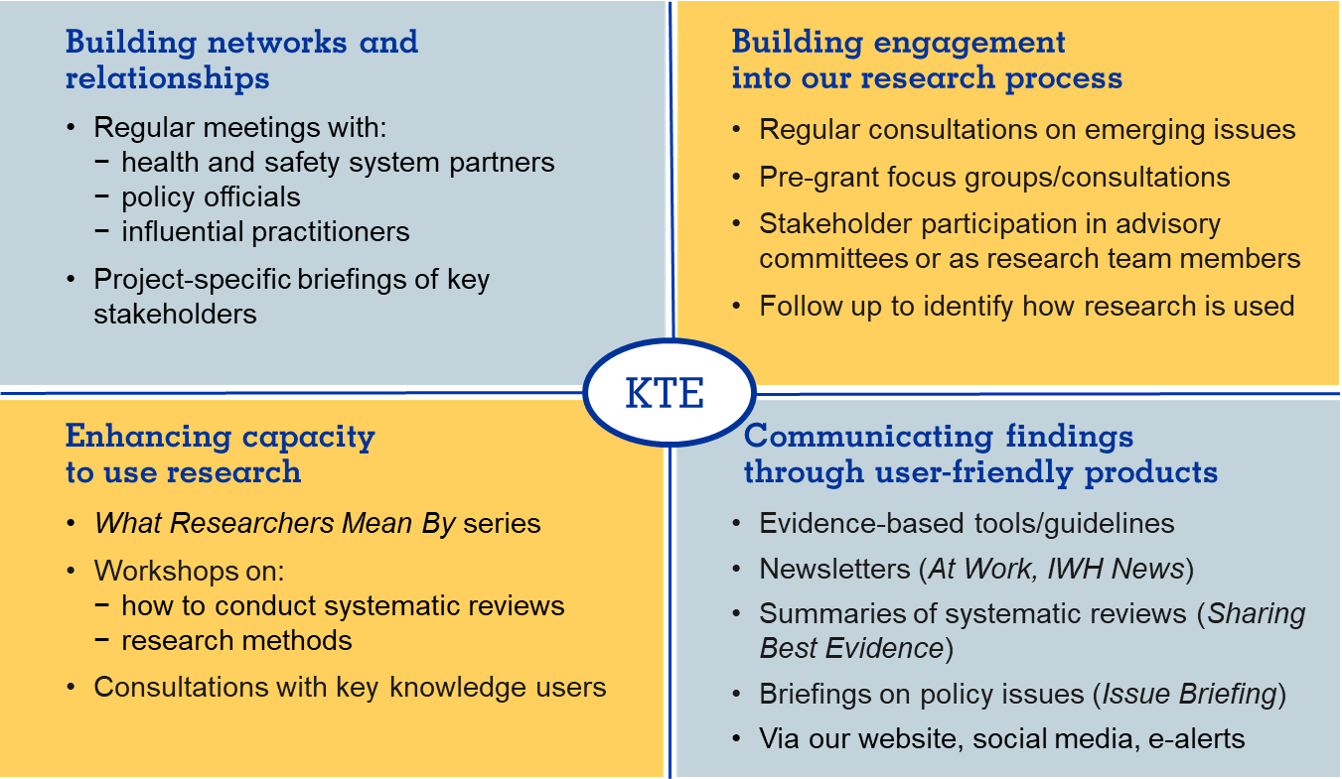
Building relationships: We have developed ongoing relationships with a variety of knowledge users in the areas of occupational health and safety and disability management. Key to building and strengthening these relationships are our formal networks with policy-makers, prevention system partners, workplace parties, professional practitioners and clinicians. We also work closely with intermediary organizations (e.g. health and safety associations, professional organizations, employer associations and labour groups) to bring our research messages to their members. Learn more about our networks.
Building engagement into research: As much as possible, we involve knowledge users and other stakeholders in specific research projects. This involvement begins early in the research process, when stakeholders provide guidance in shaping the research question and give us information about the context in which research results are likely to be used. It continues to the end of the research project, when stakeholders help us craft research messages in ways that are meaningful to the intended audience.
Enhancing capacity: We strive to help external audiences understand and apply research. We do this in a number of ways. We offer a Systematic Review Workshop to teach stakeholders and students how to conduct and share systematic reviews. We offer research presentations through our IWH Speaker Series, at which stakeholders can directly learn from, and ask questions of, our scientists. And we also offer a popular series called What Researchers Mean By…, which explains in lay-friendly language the research terms used by social scientists to report their research findings.
Communicating findings: The KTE process is supported by a corporate communications strategy that enhances the Institute’s ability to communicate effectively with its stakeholders. The communication tools include the IWH website, our monthly e-bulletin IWH News, plain-language summaries, videos, coverage in general and trade media, and social media (i.e. Twitter, LinkedIn and YouTube). We also work with our research staff and stakeholders to develop evidence-based tools and guides to help stakeholders apply our research in their own practices and policies.
Our target audiences
The target audiences or stakeholders for the Institute’s research include policy-makers (e.g. labour ministries such as Ontario's Ministry of Labour, Immigration, Training and Skills Development, workers’ compensation agencies such as the Workplace Safety and Insurance Board), health and safety associations (HSAs), workplace parties (labour and employers), related professionals (e.g. occupational health and safety, disability management, human resources, etc.) and related clinicians (e.g. chiropractors, physiotherapists, kinesiologists, occupational therapists, etc.).
Our KTE specialists
Our integrated KTE approach means that all IWH scientists, researchers and staff incorporate some KTE activities in their work. They are supported in this by a team of knowledge exchange and communication specialists. The KTE team leads and supports the Institute’s aim of putting relevant research findings into the hands of key decision-makers in a timely, accessible and useful manner. This includes:
- active building and maintenance of relationships with and among researchers, knowledge users and other stakeholders
- continuous exploration of creative and effective ways to reach more users and communicate research evidence
- working with Research Operations to build capacity in our audiences to help them better understand and use research evidence.
For more information about how we do KTE, see our KTE resources.
Our knowledge transfer principles
Five principles support our knowledge transfer and exchange practice. These principles, developed by KTE expert Dr. John Lavis (who helped build IWH's original KTE program), are represented here by five “key questions to consider.” IWH uses these when planning communication on a research finding.