





Walking, biking or taking public transit to and from work can be one way working people get physical activity into their daily routines. But what shapes people’s decision to use these active commuting options and not take the car to work?
Past studies on this question have identified several factors. These include the distance to work, the presence of bike paths, sidewalks and transit stops, and the proximity of schools and shops en route.
But most studies so far have only looked at the neighbourhoods where people live. They have not examined the neighbourhood features around both where people live and where they work. Furthermore, few studies have looked at how the built environment and social characteristics naturally cluster, thereby shaping people’s commuting habits.
That’s where a study jointly conducted by the Institute for Work & Health (IWH) and the Public Health Agency of Canada (PHAC) comes in.
Does it matter to your decision to bike or walk to work if there are plenty of bike paths near your work but hardly any around your home?
says Dr. Aviroop Biswas, IWH scientist and co-lead of the study, in explaining why the study examines both the home and work neighbourhood environments.
As for why the team studied both the built and social environments, co-lead Dr. Stephanie Prince Ware of PHAC explains: Is it just in affluent neighbourhoods where people have supportive environments to bike to work? Or is it just in high-rental neighbourhoods where people bike or bus to work because they don’t have a car? These are some of the theories that have been debated in this space,
she adds. We wanted to see what the data says about whether the socioeconomic characteristics of neighbourhoods matter.
What the researchers found
The results of the study, which has been published in the Journal of Transport & Health (doi:10.1016/j.jth.2026.102278), highlight the types of neighbourhoods where Canadians were most likely to engage in active commuting rather than take the car. These neighbourhoods, whether near home or work, had more public transit access, were more walkable, and had more bike paths and greener streets (streets with tree canopy or other vegetation).
These neighbourhoods included both those that had greater socioeconomic deprivation as well as those that were more affluent.
Our study found that the built environment that supports walking, cycling and taking public transit was linked to more active commuting in different types of neighbourhoods,
says Biswas. Whether neighbourhoods were more socioeconomically disadvantaged or more affluent did not seem to matter.
The study also underscores the importance of neighbourhood characteristics for both the home and the workplace,
adds Prince Ware.
How the study was conducted
For this study, the research team focused on adults (18 years or older) who lived within a walkable or bikeable distance from work (within 15 kilometres) and who had no long-term activity limitations due to their health.
The research team then linked different sources of data. This included data on just over two million Canadian workers captured in Statistics Canada’s 2016 long-form census. The long-form census gave them information about where Canadians lived and worked and the mode they most often used to commute.
The research team linked the home and workplace neighbourhoods to environmental data developed by the Canadian Urban Environment Health Research Consortium. Known by the acronym CANUE, this open-access platform contains data on a vast range of environmental factors—for example, air pollution, green spaces and building density—at the level of dissemination areas which represent small neighbourhoods of 400 to 700 people. For this study, the team examined neighbourhoods for walkability, public transit access, bike paths, air quality, green space and green streets.
The team also used a neighbourhood indicator of marginalization called the Canadian Marginalization Index, which is also available on CANUE. This index is a composite measure that includes four dimensions. These are:
- households and dwellings: the types and density of residential accommodations and types of family structure, as indicators of family and neighbourhood stability and cohesiveness
- material resources: household income, high school completion rates, proportions of homes needing repairs, as indicators of a neighbourhood’s levels of economic wealth or poverty
- age and labour force participation: proportions of individuals who are dependants versus those who in the labour force, as indicators of a neighbourhood’s economic vitality
- racialized and newcomer populations: proportions of immigrants or people in visible minority groups, as indicators of potential structural discrimination
Using both the built environment and social characteristics, the team identified four types of Canadian urban neighbourhoods. Below are the main characteristics that set them apart from one another.
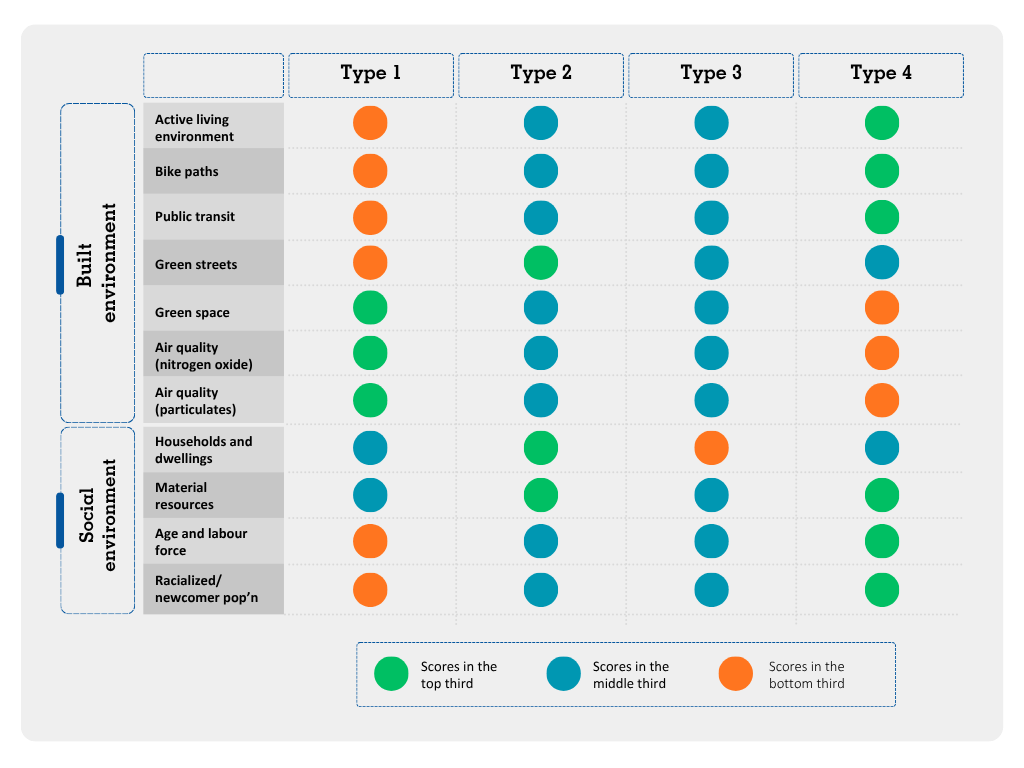
Type 1: These neighbourhoods had the least options for public transit and infrastructure that support walking and biking. They were average or in the middle of the pack in terms of material resources and housing. They also had the highest proportions of children and elders and the highest percentages of visible minorities. In Canada’s largest cities (for example, Toronto or Vancouver), these tend to be at considerable distance from the downtown core.
Type 2: These neighbourhoods were average in terms of access to transit and biking infrastructure and air quality. They were the most affluent neighbourhoods, with higher home ownership and higher income. They tend to be located at the outer peripheries of mid-sized cities (for example, Ottawa or Calgary) but can also be found closer to the core in Canada’s largest cities.
Type 3: These neighbourhoods were similar to the type 2 neighbourhoods in terms of access to transit, bike paths and other built environment characteristics. But they ranked higher on the marginalization index, with higher proportions of renters and people living alone, higher proportions of people who were unemployed, lower average incomes, and higher proportions of dependant and racialized populations.
Type 4: These neighbourhoods had the most access to public transit routes and bike paths, but the least access to green space and clean air. They ranked the lowest in material resources. They also had the smallest proportions of dependants and the highest proportions of racialized populations.
The researchers then examined how these environments around neighbourhoods where census respondents live and work were associated with their commuting habits. They used the group that both lived and worked in type 1 neighbourhoods as the comparison group.
Results showed that compared to people who lived and worked in type 1 neighbourhoods (which had the least options for public transit and infrastructure that support walking and biking), all other groups were more likely to actively commute. People who lived and worked in type 3 and type 4 neighbourhoods were the most likely to walk, bike or use public transit to get to work. People who lived in type 2 neighbourhoods but worked in type 3 or 4 neighbourhoods also tended to actively commute— but they most often took transit to work instead of biked or walked.
The study authors note the near identical commuting habits of people who lived or worked in type 3 or 4 neighbourhoods. These were neighbourhoods that had different social characteristics but relatively good active commuting infrastructure.
What the study findings suggest
These findings are an important first step in recognizing how home and work should be linked in discussions of active commuting,
says Prince Ware. These results together suggest that, within the Canadian context, built environment characteristics play an important role, regardless of neighbourhood social conditions in shaping active commuting behaviours.
A key message emerging from the study, adds Biswas, is the importance of investing in infrastructure that supports active commuting. Investing in such things as bike paths and public transit routes can have broad impact and benefit diverse neighbourhoods across the socioeconomic spectrum,
says Biswas. This investment could be effective in promoting active commuting and thereby improve people’s health and wellbeing.