
Future of work
The world of work in Canada and other industrialized countries is undergoing rapid transformation. Major forces driving change include digital technologies, artificial intelligence, climate change, demographic shifts and more. This change may bring far-reaching social, political and economic consequences for a generation of workers. IWH researchers are exploring the emerging issues posed by some of these trends—on health and safety, on work inequities, and on the inclusion of marginalized groups in the future of work—and seeking policy, system and workplace actions that can be implemented now to help ensure a healthy and inclusive future for all.
Featured

At Work article
What work and health challenges might OHS professionals face by 2040?
What challenges may face occupational health and safety practitioners and policy-makers by 2040?
Published: February 10, 2026
At Work article
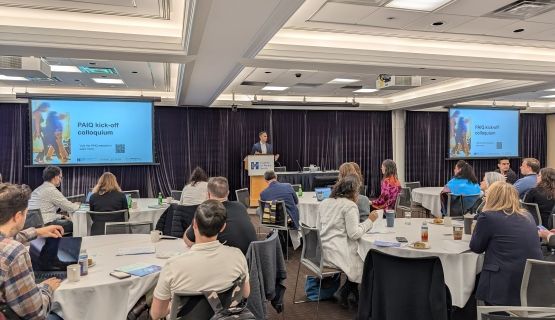
AI and job quality project gathers partners to develop roadmap
As artificial intelligence (AI) becomes more integrated into workplaces, a new IWH project wants to ensure that job quality—and the health and safety of workers—remains a top priority.
Published: January 14, 2026

IWH in the media
‘My new co-worker is shiny’: Pandemic accelerated adoption of workplace robots
As new workplace health and safety needs surface due to the pandemic, these emerging demands require fresh, dynamic solutions. For robotics, pandemic was its time to shine, writes Jack Burton, with comments from Dr. Arif Jetha from the Institute for Work & Health.
Published: OHS Canada, April 2022
Journal article
Journal article
Guest editorial. The benefits of inclusion: disability and work in the 21st century
Published: Equality, Diversity and Inclusion, April 2022
IWH Speaker Series
IWH Speaker Series
What the future of work looks like to young people with disabilities
What do young people with disabilities think about when they weigh their job options and consider their career goals? Given the massive changes expected in the world of work—changes brought on by the rise of automation, digital technologies, new forms of work, among others—what barriers and opportunities do young people with disabilities perceive on the horizon? In this presentation, IWH Scientist Dr. Arif Jetha shares findings from his interview-based study of young adults with disabilities. He also discusses what support they need to meet the challenges and take advantage of the potential opportunities of a changing labour market.
Published: December 2021
Journal article
Journal article
Fragmentation in the future of work: a horizon scan examining the impact of the changing nature of work on workers experiencing vulnerability
Published: American Journal of Industrial Medicine, June 2021
Project report
Project report
Fragmentation dans l'avenir du travail
D’ici deux décennies, le monde du travail au Canada et dans les autres pays industrialisés sera fort différent de ce qu’il est aujourd’hui. Une équipe de recherche basée à l’Institut de recherche sur le travail et la santé a entamé un projet qui vise à aider la préparation des jeunes personnes handicapées pour le monde du travail de l’avenir. Le rapport provenant de ce projet décrit neuf tendances susceptibles de modeler l’avenir du travail et leur incidence pour les travailleurs vulnérables.
Published: April 2021

At Work article
Nine trends that will likely shape future of work for groups of vulnerable workers
Climate change, artificial intelligence, robotics and automation. The world of work will look very different in the next two decades as a result of major system-wide changes. What might it hold for vulnerable workers?
Published: April 2021
Project report
Project report
Fragmentation in the future of work
In 2020, an Institute for Work & Health research team, using a method from the field of strategic foresight called horizon scanning, began exploring what the future may hold for workers, especially those in vulnerable conditions. Its findings are included in this report, which identifies nine future trends that may have a particular impact on vulnerable workers—both positive and negative.
Published: April 2021
Project
Project
Future-focused job accommodation practices for the school-to-work transition
Difficulties faced by young people during the school-to-work transition can have a lasting effect and contribute to adverse labour market outcomes that extend across one's working life. This studies explores the emerging barriers that young people with disabilities could face in accessing needed job accommodations within the changing world of work.
Status: Ongoing
Project
Project
Transitioning to the future of work: an intersectional study of vulnerable youth and young adults
This project applies an intersectional theoretical framework to explore the impact of the future of work on the transitional work experiences of vulnerable groups of young people—including women, visible minorities, immigrants, LGBTQ2+, and those with low socioeconomic status—and to uncover the overlapping structures that contribute to labour market inequities for different groups.
Status: Completed 2022
IWH Speaker Series
IWH Speaker Series
Fragmentation in the future of work: Exploring the impact of the changing nature of work on vulnerable workers
The future of work is characterized by diverse social, technological, economic, environmental and political changes, including artificial intelligence and the automation of jobs, an aging workforce, climate change. These are expected to disrupt every industry, transform working conditions and affect the types and availability of jobs. Despite a growing discourse on the changing nature of work, there is a limited understanding of how the future of work will impact vulnerable labour market groups. In this presentation, Dr. Arif Jetha outlines nine major trends that may shape the future of work and have a specific impact on vulnerable workers.
Published: February 2021