
Construction sector
IWH research that specifically involves construction workplaces, workers, unions, employers and/or associations, as well as research on programs that specifically target the construction sector, is collected together here. Not included is IWH research that cuts across all or many sectors, even though it may be relevant to the construction sector. For this reason, visitors are encouraged to explore beyond this page to find equally important information on the prevention of work injury and disability in construction.
Featured

Research Highlights
In which occupations are Ontario workers who had a work-related injury most at risk of opioid-related harms?
Formerly injured workers in certain occupations in Ontario are at an elevated risk of experiencing opioid-related harms, according to a study by IWH and the Occupational Cancer Research Centre.
Published: October 17, 2024
Impact case study
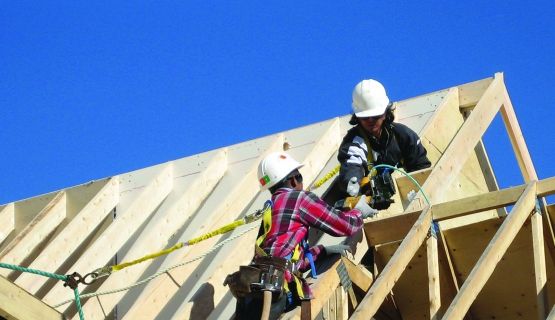
IWH evaluation of the effectiveness of the Ontario working-at-heights training standard
An IWH study on the effectiveness of Ontario's mandatory training was valuable to the labour ministry in several ways—including in reinforcing the value of program evaluations.
Published: November 21, 2023

IWH in the media
Leadership and courage key to building strong safety culture: panellists
One of the things IWH's Dr. Benjamin Amick does when he visits a work site is to do what he's not supposed to do. "I want the worker to tell me how much of an idiot I am... If (that) happens then I'm on a site that I know has a strong safety culture to begin with," he explains in a panel on safety culture. Angela Gismondi reports.
Published: Daily Commercial News, March 2018

IWH in the media
Ontario plans to review Working at Heights training
“Working at heights is one of the most dangerous types of work in the construction sector,” says Dr. Cameron Mustard, president and senior scientist, Institute for Work & Health, in an article on Ontario's plans to review working-at-heights training standards. “By working with stakeholders to evaluate the WAH standards, we will help ensure construction workers are protected on the job and will return home safely at the end of each workday.”
Published: Equipment Journal, December 2017
IWH in the media
Expert shares tools to improve site safety culture, climate
Dr. Linda Goldenhar, an expert in the safety culture and climate of construction workplaces, was in Toronto recently to discuss the research that led her team to develop a workbook to help strengthen jobsite safety and an online tool that assesses a workplace’s safety climate maturity, reports Angela Gismondi on IWH's Nachemson lecture.
Published: Daily Commercial News, December 2017
Alf Nachemson Memorial Lecture
Alf Nachemson Memorial Lecture
High-hazard industries: Addressing safety culture, climate and leadership to improve outcomes
In this lecture Dr. Goldenhar talks about the research that led her team to develop, first, a workbook to help strengthen jobsite safety climate by improving performance in eight areas identified as leading indicators of health and safety outcomes and, more recently an online tool that assesses a workplace’s safety climate maturity. Dr. Goldenhar also shares preliminary evaluation findings of a program that she and her team developed to improve jobsite supervisory leadership—one of the eight safety climate leading indicators identified as critical by construction stakeholders.
Published: November 2017
IWH in the media
Construction among highest spending sectors to prevent work-related injuries
The construction sector is in the top five of 17 sectors in terms of spending per worker per year on preventing work-related injury and illness, says the president and senior scientist at the Institute for Work and Health (IWH) who is conducting a pilot study on the matter
Published: Daily Commercial News, May 2017
IWH in the media
Work injuries have dipped: IWH report
A study conducted by the Institute for Work & Health (IWH) shows work-related injuries in Ontario declined by 30 per cent from 2004 to 2011, reaffirming the efforts made by employers to make the workplace safe, states Patrick McManus, chair of the Ontario Construction Employers Coalition (CEC).
Published: Daily Commercial News, April 2017
Project
Project
Addressing literacy and numeracy gaps among workers in an OHS training program: a pilot study
Can we improve occupational health and safety (OHS) outcomes by embedding literacy and numeracy into OHS training? IWH researchers aimed to find out, by assessing a hoisting and rigging program that embeds these essential skills into the training.
Status: Completed 2017
Project
Project
Identifying relevant OHS leading indicators in Manitoba's construction sector
IWH is collaborating with the Construction Safety Association of Manitoba (CSAM) to identify relevant leading indicators of injury and illness in the province’s construction sector, and to encourage their use through tools that creates a conversation about best practices in the sector.
Status: Completed 2019
Project
Project
Evaluating prevention strategies to reduce the risk of work-related cancers in Ontario’s construction sector
An IWH study is estimating future incidences cancers among construction workers in Ontario as a result of workplace exposures, and estimating the costs and benefits of intervention programs to reduce these exposures.
Status: Completed 2021
Project
Project
Evaluating the implementation and effectiveness of Ontario’s working-at-heights training standard
IWH researchers are examining the effectiveness of Ontario’s mandatory working-at-heights training standard and what is being learned about its implementation in construction workplaces.
Status: Completed 2021