
Construction sector
IWH research that specifically involves construction workplaces, workers, unions, employers and/or associations, as well as research on programs that specifically target the construction sector, is collected together here. Not included is IWH research that cuts across all or many sectors, even though it may be relevant to the construction sector. For this reason, visitors are encouraged to explore beyond this page to find equally important information on the prevention of work injury and disability in construction.
Featured

Research Highlights
In which occupations are Ontario workers who had a work-related injury most at risk of opioid-related harms?
Formerly injured workers in certain occupations in Ontario are at an elevated risk of experiencing opioid-related harms, according to a study by IWH and the Occupational Cancer Research Centre.
Published: October 17, 2024
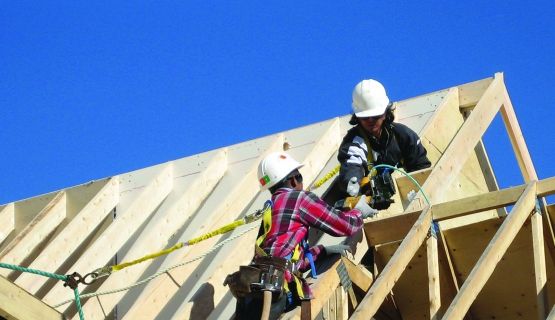
Impact case study
IWH evaluation of the effectiveness of the Ontario working-at-heights training standard
An IWH study on the effectiveness of Ontario's mandatory training was valuable to the labour ministry in several ways—including in reinforcing the value of program evaluations.
Published: November 21, 2023
Journal article
Journal article
Return-to-work after work-related injury in the construction sector: a scoping review
Published: Journal of Occupational Rehabilitation, February 2022
Journal article
Journal article
Unionisation and injury risk in construction: a replication study
Published: Occupational & Environmental Medicine, January 2022
Journal article
Journal article
Break-even analysis of Respirable Crystalline Silica (RCS) exposure interventions in the construction sector
Published: Journal of Occupational & Environmental Medicine, November 2021

IWH in the media
Work-related skin cancer among construction workers set to double by 2060
Cases of work-related non-melanoma skin cancer among construction workers in Ontario are on track to double by 2060. However, according to new research done by the Institute for Work & Health (IWH), if protective equipment and clothing such as long-sleeve shirts, pants and neck coverings are worn by construction workers, up to 6,034 cases of such cancers could be averted over the next three decades. That would result in $38 million in costs (in 2017 Canadian dollars) being saved over a 30-year period, Grant Cameron reports.
Published: Daily Commercial News, July 2021

At Work article
Costs of providing UV ray protection at job sites outweighed by averted skin cancers
Ultraviolet radiation due to sun exposure is one of the most common causes of work-related cancer in Ontario. A new study by IWH examines the costs and benefits of providing protective clothing and shade shelter to avert work-related skin cancer over 30 years.
Published: May 2021

IWH in the media
How does unionization make a difference with workplace safety?
The union safety effect is real — at least in Ontario’s major construction sector, writes John Dujay in reporting on research findings from IWH Scientist Dr. Lynda Robson
Published: Canadian HR Reporter, April 2021

At Work article
Union firms have lower lost-time claim rates, study in ICI construction confirms
Five years ago, an IWH study found lower lost-time injury claim rates in unionized firms in Ontario's industrial, commercial and institutional construction sector. A new study uses more recent data to see if it can replicate the observed "union safety effect."
Published: January 2021
Project report
Project report
Updating a study on the union effect on safety in the ICI construction sector
IWH updated a previous study on the union safety effect in Ontario's industrial, commercial and institutional construction sector. Like the first study, the update found unionization was associated with a lower risk of injuries requiring time away from work, including both musculoskeletal and critical (more severe) injuries.
Published: January 2021
IWH Speaker Series
IWH Speaker Series
The union effect on safety in the ICI construction sector: a study update
A study conducted several years ago by the Institute for Work & Health found unionized companies in Ontario's institutional, commercial and industrial (ICI) construction sector had a lower rate of lost-time injury claims than their non-unionized counterparts, after accounting for other factors like company size. In this presentation, Dr. Lynda Robson shares an update of that study, using data from 2012-2018. She discusses whether the latest results support what's called a "union safety effect", and how findings vary by company size and types of construction work.
Published: January 2021

Research Highlights
Evaluating the effectiveness of mandatory working-at-heights training standards
The introduction of a mandatory training standard for construction workers using fall protection equipment is associated with a 19.6 per cent reduction in the incidence rate of lost-time claims due to falls targeted by the intervention. This decline is larger than an overall decline in injuries in the sector during the same time frame. Reductions in incidence rates are also largest among the smallest employers.
Published: September 2020